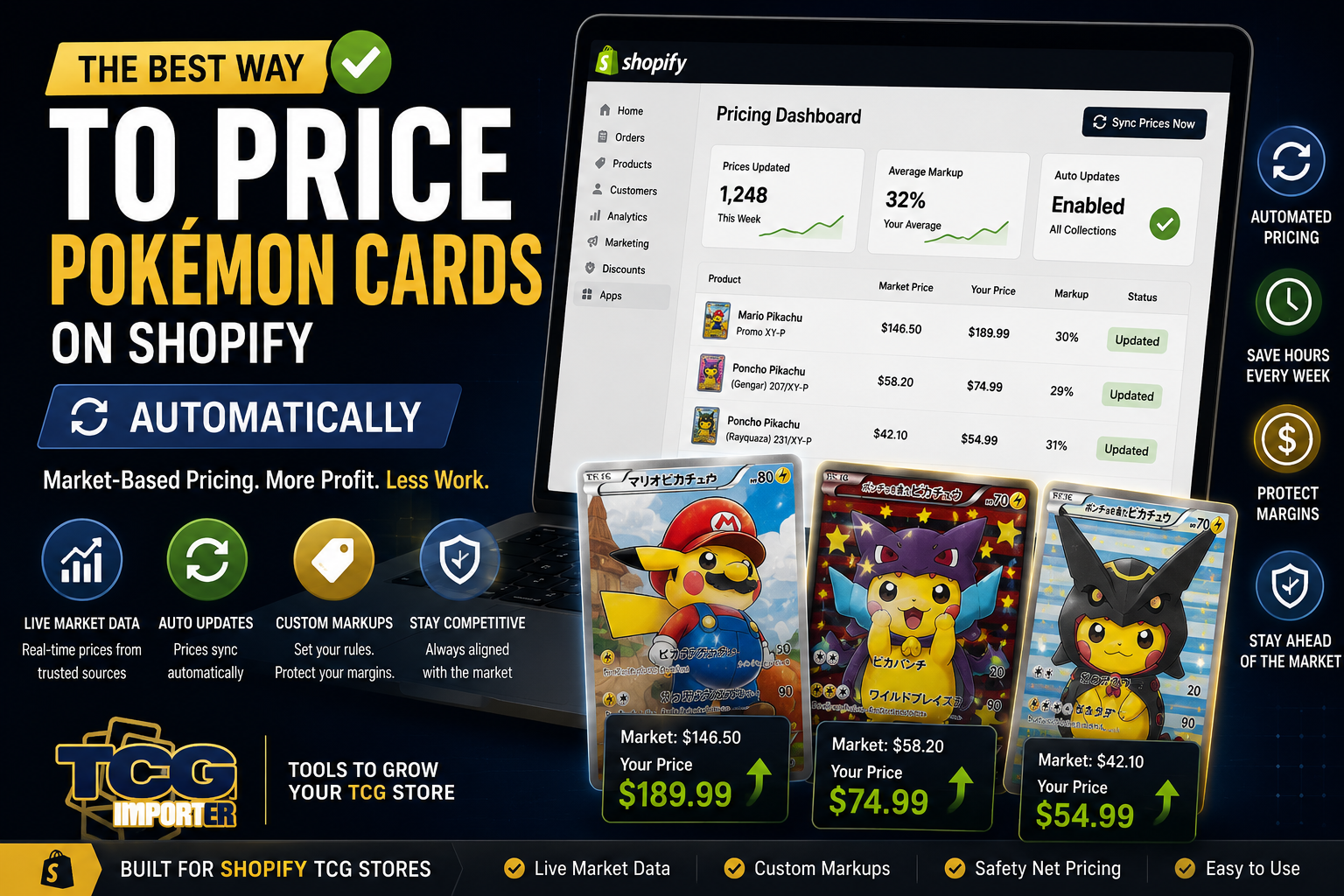
The best way to price Pokémon cards on Shopify is to use market-based pricing, automated updates, and clear pricing rules that protect your margins.
Pricing Pokémon cards correctly is one of the hardest parts of running a TCG store. Unlike most products, card prices are not fixed. They constantly change based on demand, rarity, condition, supply, hype cycles, tournament results, and overall market trends.
A card worth $5 today could be $15 next week, or it could drop overnight. If you are manually pricing cards in your Shopify store, you are either spending hours updating listings, falling behind the market, or losing money without realising it.
In this guide, we’ll cover the best way to price Pokémon cards on Shopify automatically so your TCG store stays competitive without the manual work.
Table of Contents
- Why Pricing Pokémon Cards Is So Difficult
- Why Manual Pricing Fails
- The Smarter Approach: Market-Based Pricing
- How to Automatically Price Pokémon Cards on Shopify
- Frequently Asked Questions
Why Pricing Pokémon Cards Is So Difficult
Running a TCG store is not like running a standard ecommerce store. Most products in a normal Shopify store have stable wholesale costs, predictable margins, and slower price movement. Pokémon cards are different.
Card prices can change quickly because the market is driven by collectors, players, set popularity, rarity, grading demand, sealed product availability, and online hype. This makes pricing one of the most important parts of running a profitable Pokémon card store.
- Prices can change daily based on demand
- Rarity heavily affects value
- Supply varies between sets and releases
- Popular cards can spike after content creator coverage
- Older cards may move differently from modern sealed products
- Chase cards can shift the value of an entire set
On top of that, many TCG stores manage hundreds or thousands of products. Keeping every price updated manually becomes nearly impossible once your store starts to scale.
Why Manual Pokémon Card Pricing Fails
Before switching to automation, most TCG store owners try to manage pricing manually. This can work for a small number of products, but it quickly breaks down as your inventory grows.
Guess Pricing
Some stores price Pokémon cards based on instinct or rough estimates. This often leads to inconsistent pricing, missed profit, and products that are either too cheap or too expensive.
Copying Competitors
Other stores manually check competitor websites and copy prices. This is time-consuming and often unreliable because competitor prices may already be outdated or based on a different business model.
Set It and Forget It Pricing
Some stores set prices once and rarely update them. This is risky in the Pokémon market because card values can move quickly. A stale price can cause lost profit, slow sales, or inaccurate product positioning.
- Overpriced cards may sit unsold
- Underpriced cards can lose margin
- Manual updates take hours every week
- Market changes are easy to miss
- Large inventories become difficult to manage
The Best Way to Price Pokémon Cards on Shopify
The best way to price Pokémon cards on Shopify is to use real market data, automated pricing rules, and a system that can keep your product prices updated without constant manual work.
Successful TCG stores do not guess prices. They use market-based pricing systems that help protect margin and keep products competitive.
Market-based pricing helps your store stay aligned with real card values instead of relying on outdated spreadsheets or manual checks.
- Track market values
- Apply your own markup rules
- Use minimum price thresholds
- Round prices consistently
- Sync updates back into Shopify
- Reduce human error
- Save hours of manual work
For general ecommerce pricing strategy, Shopify also recommends considering margins, competitor pricing, value perception, and costs when setting product prices: Shopify product pricing guide.
Why Automated Pricing Gives TCG Stores an Advantage
Automated pricing is not just about convenience. It can directly affect your profitability, competitiveness, and ability to scale.
If your Shopify store has hundreds or thousands of Pokémon cards, manually checking every product is not realistic. Automation allows you to manage large catalogues while keeping pricing more consistent.
- Saves hours every week
- Keeps prices closer to market value
- Helps protect profit margins
- Reduces manual errors
- Makes large catalogues easier to manage
- Allows your store to scale faster
How to Automatically Price Pokémon Cards on Shopify
Here is how automated Pokémon card pricing works when using a dedicated Shopify TCG pricing tool.
Step 1 — Connect to Market Pricing Data
The first step is connecting your store to a reliable pricing source. Market pricing data helps your store understand what cards are currently worth instead of relying on static manual prices.
This is especially useful for singles, chase cards, popular sets, and products where price movement is common.
Step 2 — Sync Prices to Shopify
Once pricing data is available, your pricing tool can sync updated prices back into Shopify. This removes the need to manually open each product and update the price yourself.
For large TCG stores, this is one of the biggest time-saving benefits.
Step 3 — Apply Custom Markups
Market value alone is not enough. Your store still needs margin. A strong pricing system should allow you to apply custom markups so your products are priced in a way that supports your business.
- Percentage-based markups
- Minimum price thresholds
- Safety net pricing
- Manual overrides when needed
- Rounding rules such as .95 or .99 endings
Step 4 — Review Pricing Before Publishing
Automation should save time, but store owners should still have control. Review your pricing rules and product settings to make sure your strategy matches your margins, customer base, and product type.
Step 5 — Let Pricing Sync Automatically
Once your rules are configured, automated pricing can help keep your Shopify store updated without constant manual checks. This is one of the most efficient ways to price Pokémon cards on Shopify at scale.
How TCG Importer Helps Price Pokémon Cards on Shopify
TCG Importer was built specifically for Shopify TCG stores that need to import products, manage pricing, and scale their catalogue without relying on repetitive manual work.
With TCG Importer, stores can use pricing tools designed for trading card products, including live pricing workflows, markup controls, manual pricing options, and safety net pricing.
- Sync prices automatically
- Stay aligned with market values
- Apply custom markups
- Use safety net pricing
- Control manual overrides
- Manage large catalogues more efficiently
- Reduce repetitive price updates
If you want the best way to price Pokémon cards on Shopify, automation gives your store a major advantage over manual workflows.
Related TCG Importer Guides
- How to Import Pokémon Cards into Shopify
- How to Manage Large TCG Inventories on Shopify
- Best Shopify Apps for TCG Stores
- Start using TCG Importer
Frequently Asked Questions
What is the best way to price Pokémon cards on Shopify?
The best way to price Pokémon cards on Shopify is to use market-based pricing with automated updates, custom markups, and pricing rules that protect your margins.
Can I automatically update Pokémon card prices in Shopify?
Yes. A dedicated TCG pricing tool can help automatically update Pokémon card prices in Shopify based on market data and your own pricing rules.
Why is manual Pokémon card pricing risky?
Manual pricing is risky because Pokémon card prices can change quickly. If prices are not updated regularly, products can become overpriced, underpriced, or misaligned with the market.
Does TCG Importer support custom markups?
Yes. TCG Importer supports pricing controls that help Shopify TCG stores apply markups and manage pricing more efficiently.
Should TCG stores use automated pricing?
Yes. Automated pricing is highly useful for TCG stores because it saves time, reduces manual errors, and helps keep product prices aligned with changing market values.
Final Thoughts: Stop Pricing Pokémon Cards Manually
Pricing is one of the most important parts of running a profitable Pokémon card store. If your prices are too high, products may not sell. If your prices are too low, you lose margin.
The stores that grow fastest are the ones that adapt to market changes, automate repetitive work, and build systems that help them scale.
If you are serious about running a scalable Shopify TCG store, the best way to price Pokémon cards on Shopify is to use automated pricing tools built for the TCG market.
Start using TCG Importer today and automate your Pokémon card pricing workflow.
Pingback: Best Shopify Apps for TCG Stores (2026 Guide)
Pingback: Effortlessly Import Pokémon Cards into Shopify Today
Pingback: 2026 Pokémon TCG Set Releases: Prepare Your Store Now
Pingback: How to Start a Successful TCG Store on Shopify Today